Social Media Video Editors
Reels, Shorts and social clips requiring strong hooks, captions, pacing, sound and platform-ready vertical formats.

Helping businesses hire Video Editors, Short-Form Editors, YouTube Editors, Motion Graphics Editors and Post-Production Specialists who can turn raw footage, scripts and creative briefs into polished, platform-ready videos.
DISHA Recruitment supports employers with requirement understanding, targeted sourcing, portfolio-led screening and practical shortlisting for video editing and digital content roles.
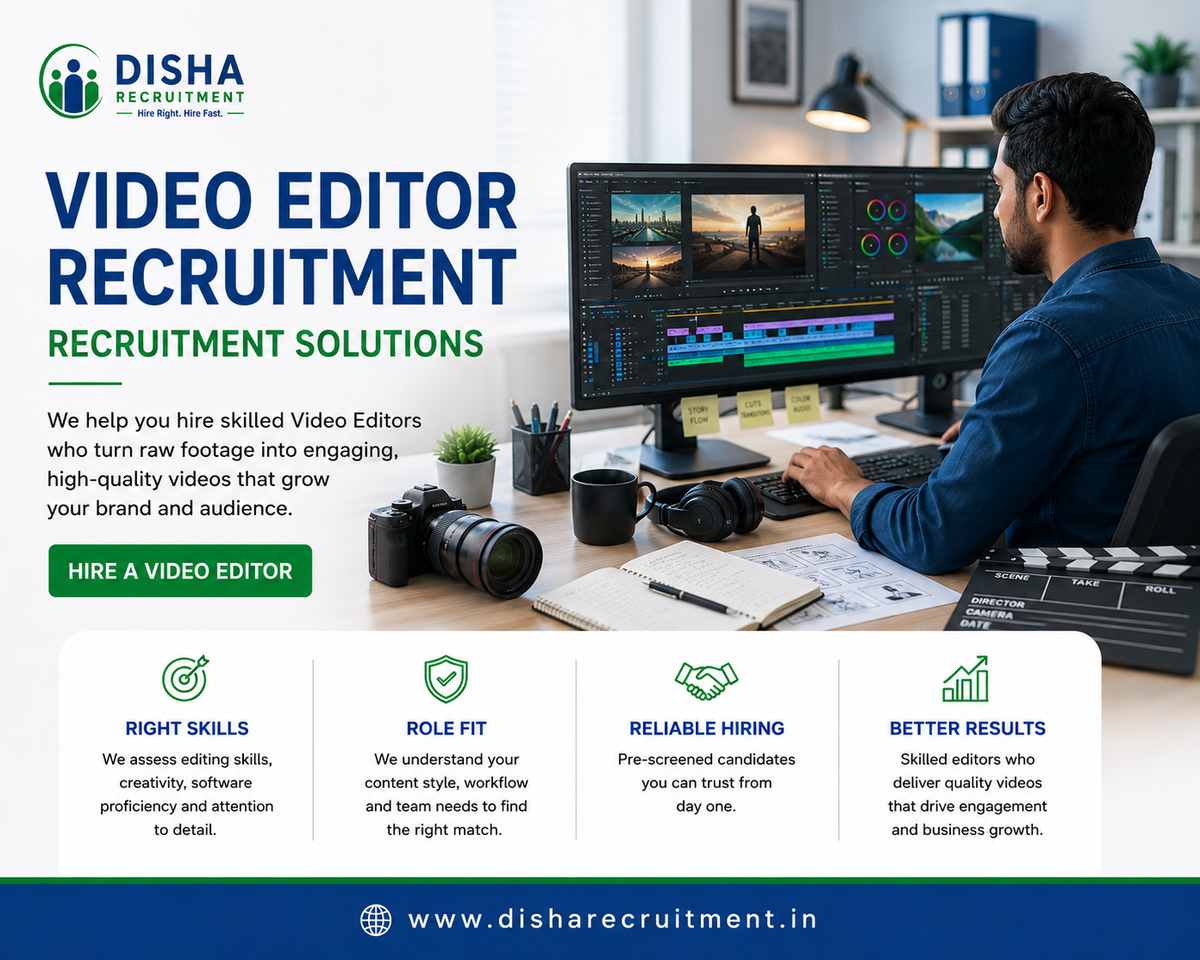
Current video editing jobs being handled by DISHA Recruitment in Bangalore.
“Video Editor” can cover very different production needs. Define the content format, audience, platform and workflow before comparing candidates.
Reels, Shorts and social clips requiring strong hooks, captions, pacing, sound and platform-ready vertical formats.
Interviews, educational videos, podcasts and explainers where structure, storytelling and sustained viewer interest matter.
Campaign creatives, product videos and promotional edits built around a clear message, brand style and audience action.
Editors who can combine cutting with titles, animated graphics, captions, transitions and visual effects where required.
Training, internal communication, product explainers, testimonials and structured business videos that need clarity and consistency.
Turning long recordings into highlights, clips and platform-specific edits while maintaining consistent visual and audio treatment.
A strong Video Editor hire starts with the real production workflow. Define the output, review relevant work and assess how the editor handles tools, briefs, feedback, deadlines and delivery.
Specify content type, platforms, typical duration, output volume, audience, style and who owns the creative brief.
Identify the software, aspect ratios, export requirements, audio expectations, colour work and motion-graphics level actually needed.
Compare samples similar to your real requirement. A polished long-form edit does not automatically prove fast-paced short-form capability.
If a test is necessary, use a realistic brief with reasonable footage and scope. Assess the work you genuinely need the employee to perform.
Look beyond software knowledge: shot selection, rhythm, continuity, hook strength, narrative clarity and audience fit are core editing judgements.
Editors often work through revisions. Assess communication, responsiveness, file organisation, version control and deadline discipline.
The weighting should change with the role. A short-form social editor, performance-video specialist and corporate post-production editor should not be assessed against exactly the same checklist.
Shot selection, structure, pacing, continuity and the ability to turn raw footage into a clear visual story.
Working knowledge of the tools required by the role, such as Premiere Pro, DaVinci Resolve, Final Cut Pro or equivalent software.
Titles, captions, transitions, motion graphics and visual effects where the production requirement calls for them.
Clean dialogue, balanced music, basic sound treatment and appropriate colour correction or grading for the intended output.
Understanding of framing, aspect ratio, captions, safe areas, duration and export requirements across different channels.
Organised project files, version control, asset handling, reliable handover and the ability to manage recurring production work.
Ability to interpret briefs, work with content and marketing teams, handle revisions and communicate practical production constraints.
Useful familiarity with AI-enabled editing or content tools can be valuable when the role uses them, but it should remain a role-specific requirement rather than an automatic must-have.
A resume can show experience, but relevant video work often gives employers a clearer view of editing judgement, pacing, storytelling, technical range and the formats an editor is comfortable producing.
Portfolio review should still be tied to the actual vacancy. A candidate editing Reels at high volume may be excellent for social content but not necessarily the right fit for a long-form YouTube, corporate or post-production workflow.
Clear decisions about the working model and production expectations make it easier to shortlist Video Editors who can actually fit the team.
Decide how closely the editor needs to work with creators, marketing or production teams and whether the role requires on-site coordination.
Choose between an all-round editor and a specialist in Reels, YouTube, ads, motion graphics, podcasts or corporate video.
Separate production-focused editing from roles expected to suggest hooks, formats, visual treatments or creative concepts.
Define quality, turnaround, output volume, revision cycles, brand consistency and the level of independent ownership expected.
Knowing Premiere Pro, DaVinci or another tool does not automatically demonstrate storytelling, pacing, judgement or brand understanding.
A polished reel may still be a poor match if the editor has not worked in the format, pace, audience or production style your business needs.
A practical assessment can help, but a large unpaid assignment may measure willingness to do free work rather than the specific skill being hired.
Strong visuals are not enough. Audio, exports, file organisation, revisions and deadlines can materially affect the production workflow.
Some professionals shoot and edit; others specialise in post-production. Define camera responsibilities separately instead of assuming the two roles are identical.
Long mandatory lists can narrow the pool unnecessarily. Prioritise the capabilities the actual video workflow requires from day one.
We begin with the employer's actual content workflow and shortlist against the technical, creative and practical criteria that matter.
Content type, platforms, volume, software, experience and workflow.
Search for editors aligned with the defined production requirement.
Review experience, communication and relevant portfolio fit.
Present relevant profiles for employer evaluation and interview.
Coordinate next steps around the employer's hiring process.
The employer makes the final selection and hiring decision.
Common questions employers should consider when hiring Video Editors in Bangalore.
Yes. DISHA Recruitment can support employers with Video Editor hiring requirements in Bangalore based on content format, experience, technical requirements, portfolio fit and other employer criteria.
Depending on the requirement, employers can discuss short-form social editors, YouTube and long-form editors, advertising and brand video editors, motion graphics editors, corporate video editors and podcast or content-repurposing editors.
Evaluate relevant portfolio work, storytelling, pacing, editing software, motion graphics where required, audio and colour ability, platform awareness, workflow discipline, turnaround and response to feedback.
A focused practical test can be useful when it reflects the real role. Keep the scope reasonable, use a realistic brief and evaluate the specific skills the employer actually needs.
Portfolio evidence can be particularly valuable for editing roles because it shows actual work. It should still be assessed alongside experience, technical requirements, communication and the employer's workflow.
Not automatically. Some roles combine shooting and editing, while others are dedicated post-production positions. Employers should define camera, lighting and on-location responsibilities separately if they are part of the job.
Start by defining the video formats, platforms, output volume, software, experience level and expected turnaround. Then review relevant portfolios, assess role-specific technical and creative skills and compare shortlisted candidates against consistent criteria.
Share the type of videos you produce, experience requirement, workflow and technical expectations. DISHA Recruitment can discuss the hiring requirement and suitable recruitment approach.